


In stock - 10 шт.
eSUN eFlex TPU-87A Clear Flexible TPU Filament 1 kg eSUN eFlex TPU-87A Clear Flexible TPU Filament ...
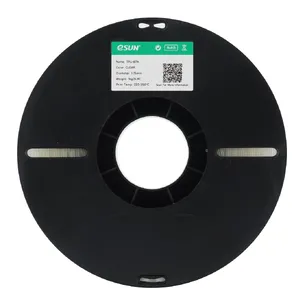
eSUN eFlex TPU-87A Clear Flexible TPU Filament 1 kg eSUN eFlex TPU-87A Clear Flexible TPU Filament ...
TPU-87A / eFlex TPU-87A is a soft clear flexible TPU filament by eSUN for FDM/FFF 3D printing. It is designed for elastic, cushioning, impact-resistant and soft-touch parts that require more flexibility than standard TPU-95A. With Shore 87A hardness, eFlex TPU-87A is well suited for protective cases, dampers, soft pads, sporting accessories, wearable products, shoe elements, gaskets, seals and functional prototypes.
The main advantage of eSUN eFlex TPU-87A is its combination of softness, high stretchability, strength and a clear visual effect. After FDM/FFF printing, it is not glass-clear: printed parts usually look clear or translucent depending on wall thickness, wall count, infill, nozzle temperature, print speed, filament moisture and feeding quality.
TPU-87A is a flexible thermoplastic polyurethane with Shore 87A hardness. Compared with common TPU-95A, it is softer, bends more easily and provides stronger cushioning. Compared with very soft TPE materials, it remains more controllable, stronger and more suitable for functional parts.
The eSUN eFlex line is intended for applications where rigid plastics are not suitable: the part must bend, compress, absorb vibration, protect a housing, withstand stretching or return to its original shape after deformation. This makes TPU-87A a good material for flexible cases, protective elements, soft holders, elastic inserts and bending parts.
The main color of the line is Clear / Natural / Transparent. For product cards, use Clear TPU-87A in English, прозрачный TPU-87A in Russian and прозорий TPU-87A in Ukrainian.
| Color | Description | Best applications |
|---|---|---|
| Clear / Natural / Transparent | Clear or translucent flexible appearance after printing. | Cases, dampers, protective pads, soft inserts, wearable parts, technical prototypes. |
| Property | Value |
|---|---|
| Brand | eSUN |
| Line | eFlex |
| Material | TPU-87A / eFlex TPU-87A |
| Material type | Soft clear flexible TPU filament |
| Hardness | Shore 87A |
| Color | Clear / Natural / Transparent |
| Diameter | 1.75 mm |
| Spool weight | 1 kg |
| Print technology | FDM / FFF |
| Recommended feeding system | Direct Drive / short filament path |
| Main applications | Flexible cases, dampers, cushioning inserts, sporting accessories, soft pads, shoe elements, technical prototypes |
| Property | Value |
|---|---|
| Density according to TDS | 1.12 g/cm³ |
| Tensile strength | 52 MPa |
| Elongation at break | 500% |
| Melt flow index | N/A |
| Flexural strength | N/A |
| Flexural modulus | N/A |
| IZOD impact strength | N/A |
| Heat deflection temperature | N/A |
| Material behavior | Soft, flexible, strong, resilient, impact-resistant |
| Parameter | Recommended value |
|---|---|
| Drying before printing | 55 ℃ for more than 4 hours |
| Nozzle temperature | 220–250 ℃ |
| Bed temperature | 45–60 ℃ |
| Printing speed | 20–50 mm/s |
| Recommended starting speed | 20–30 mm/s for first tests |
| Fan speed | 100% |
| Retraction | Minimal, tune by testing |
| Recommended extruder | Direct Drive / short filament path |
| Bowden / remote extruder | Not recommended |
TPU-87A is clear, but FDM/FFF printing builds models from individual lines, so the finished part usually looks translucent. To achieve a cleaner clear effect, reduce internal gaps, stabilize feeding and keep moisture away from the filament.
| Material | Hardness / behavior | When to choose |
|---|---|---|
| eLastic / TPE-83A | Very soft elastic material | When maximum softness and rubber-like behavior are required |
| eFlex TPU-87A | Soft clear TPU Shore 87A | When a soft, flexible, clear and cushioning part is needed |
| TPU-95A | Denser and harder TPU Shore 95A | When more stable printing and a less soft functional part are needed |
| TPU-LW | Lightweight foamable TPU with adjustable density | When a lightweight flexible part with foaming behavior is needed |
eSUN eFlex TPU-87A is compatible with FDM/FFF 3D printers using 1.75 mm filament and supporting a 220–250 ℃ nozzle temperature range. It can be printed on Bambu Lab, Creality, Prusa, Anycubic, Elegoo, Sovol, QIDI, Flashforge and other popular 3D printers when flexible filament feeding is properly tuned.
For TPU-87A, Direct Drive extruders are preferred. Bowden systems or remote extruders are not recommended because soft Shore 87A material is harder to push reliably through a long tube. For stable results, use a short filament path, low speed, minimal retraction and dry filament.
TPU-87A should be printed in a well-ventilated area. The material can burn when exposed to ignition sources, so the spool should be stored away from open flames, sparks, hot surfaces and strong oxidizing agents. During mechanical processing of printed parts, safety glasses and a mask are recommended if dust is generated.
The filament should be stored in a dry place, preferably in a sealed bag or container with desiccant. After opening, the material should not be left in a humid room for a long time. For long print jobs, using a filament dry box or eBOX is recommended.
Yes. TPU-87A is softer and more flexible than TPU-95A. It is better suited for parts that require strong elasticity, softness and cushioning. The filament is clear, but after FDM/FFF printing, parts usually become translucent rather than glass-clear. Final clarity depends on wall thickness, infill, temperature, speed and drying. It is not recommended. eFlex TPU-87A prints better with Direct Drive or a short filament path. Soft TPU 87A is harder to feed reliably through a long Bowden tube. Yes. Drying at 55 ℃ for more than 4 hours before printing is recommended. Dry material prints more consistently and provides a cleaner surface. It is suitable for flexible cases, dampers, cushioning inserts, sporting accessories, soft pads, shoe elements, gaskets, protective parts and elastic technical prototypes. eFlex TPU-87A is a soft clear TPU with fixed Shore 87A hardness. TPU-LW is a lightweight foamable TPU whose density and softness change depending on foaming settings. A Direct Drive extruder with a short filament path is recommended. It helps prevent soft filament compression and makes printing more stable. Is TPU-87A softer than TPU-95A?
Is eFlex TPU-87A fully transparent?
Can TPU-87A be printed on a Bowden printer?
Does TPU-87A need drying?
What is clear TPU-87A best for?
How is eFlex TPU-87A different from TPU-LW?
Which extruder is better for TPU-87A?
eSUN eFlex TPU-87A is a specialized material for soft, flexible and impact-resistant parts. It is useful when PLA, PETG or harder TPU cannot provide the required elasticity. With Shore 87A hardness, a clear effect and high stretchability, it is suitable for protective cases, dampers, sporting accessories, soft pads, shoe elements, wearable products and technical prototypes.