


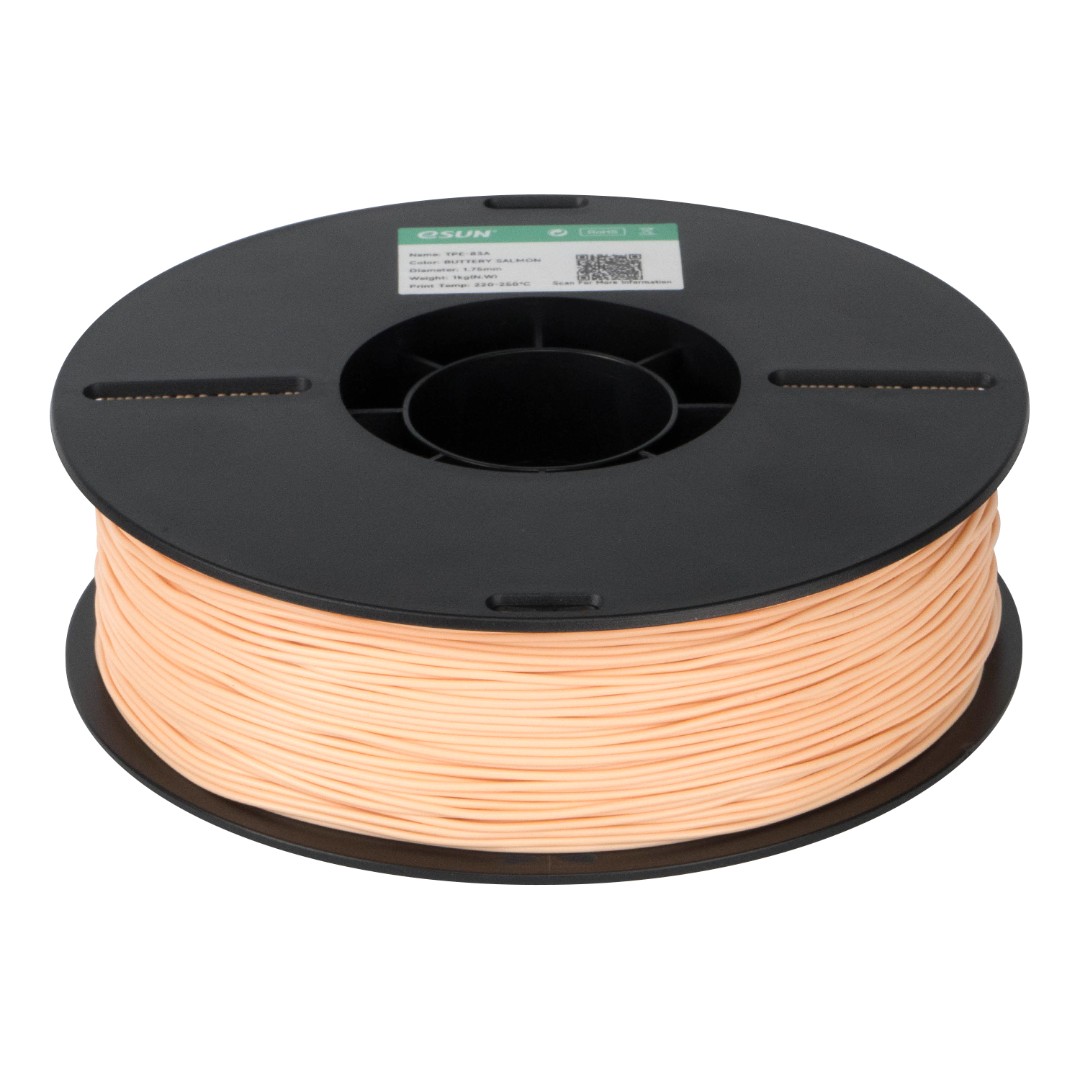
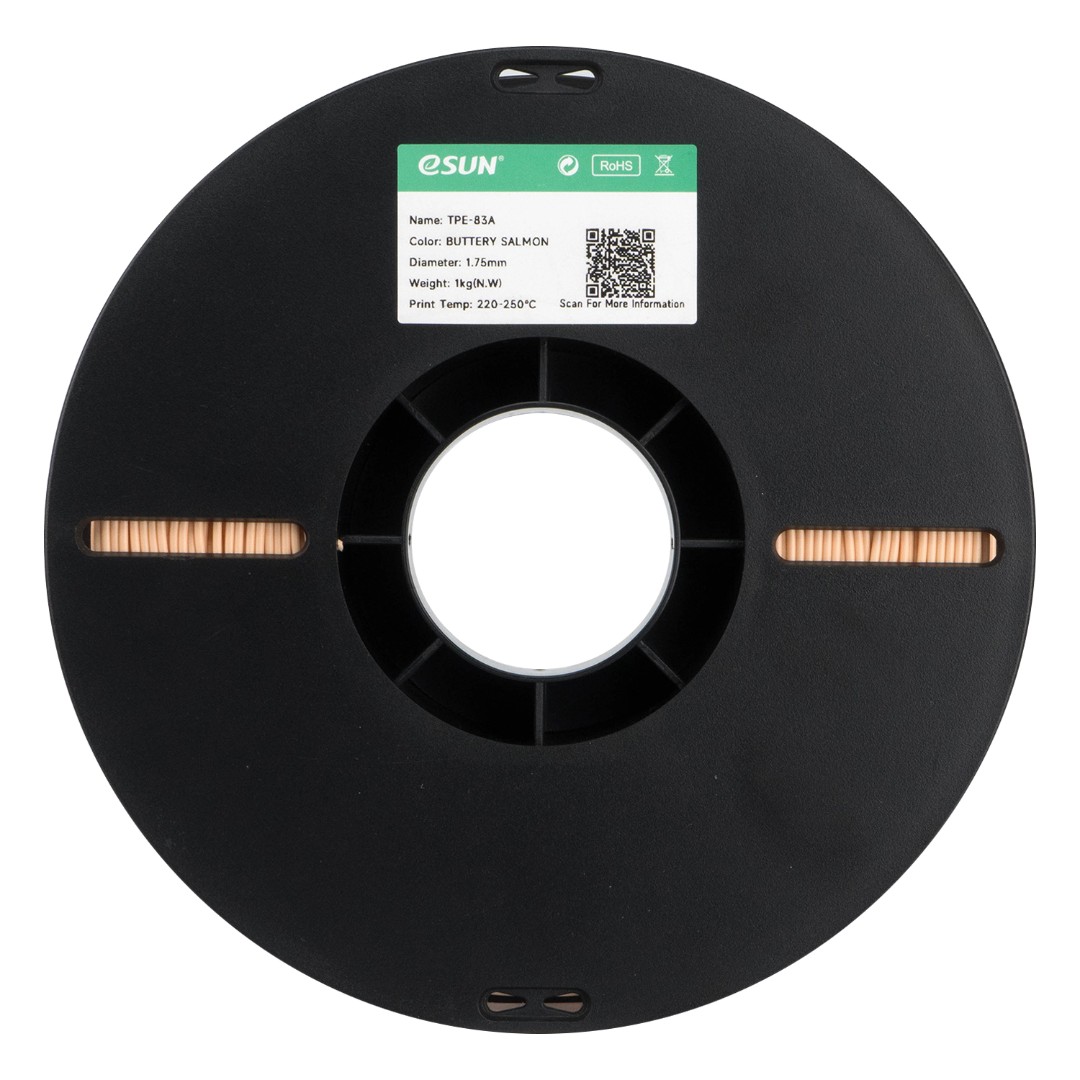
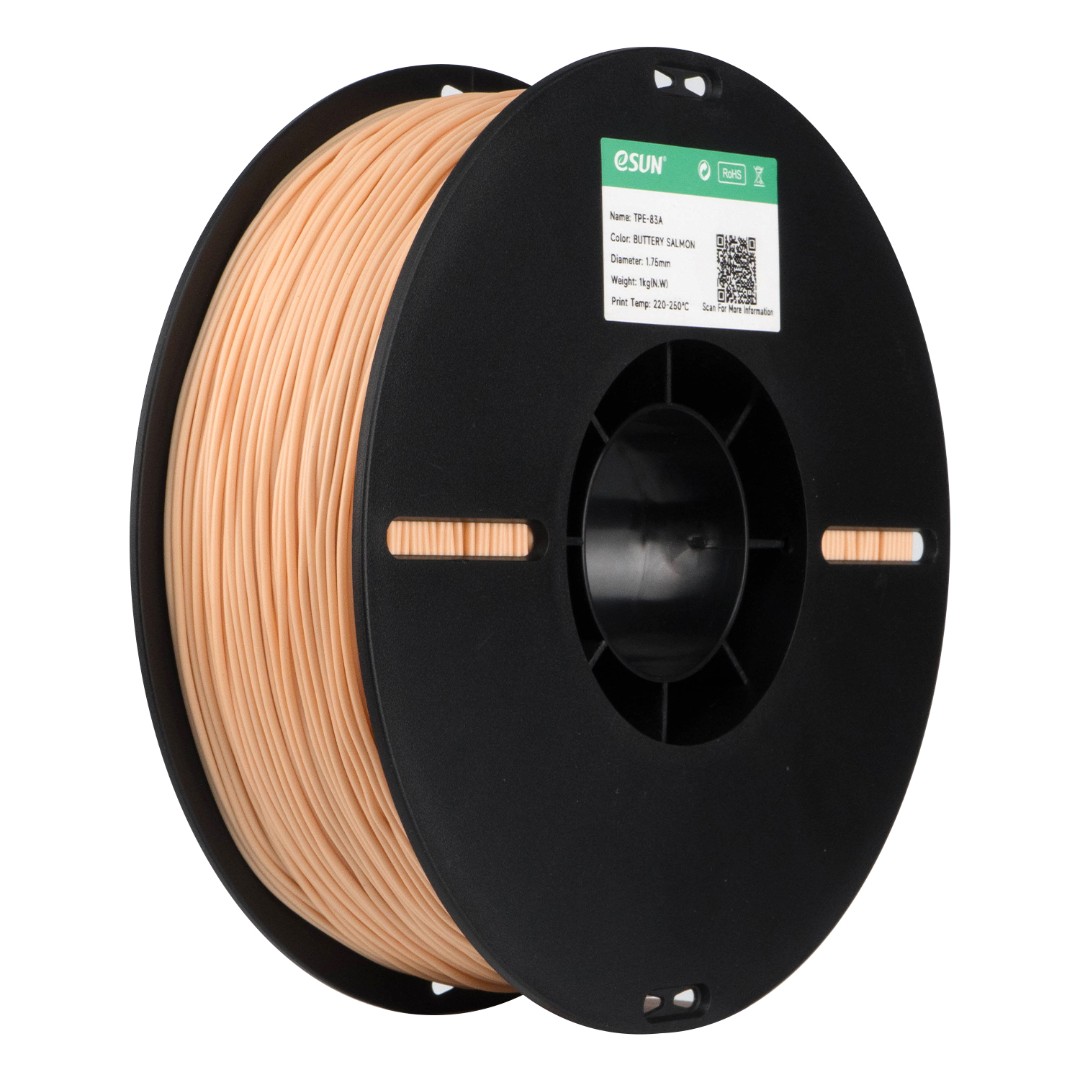
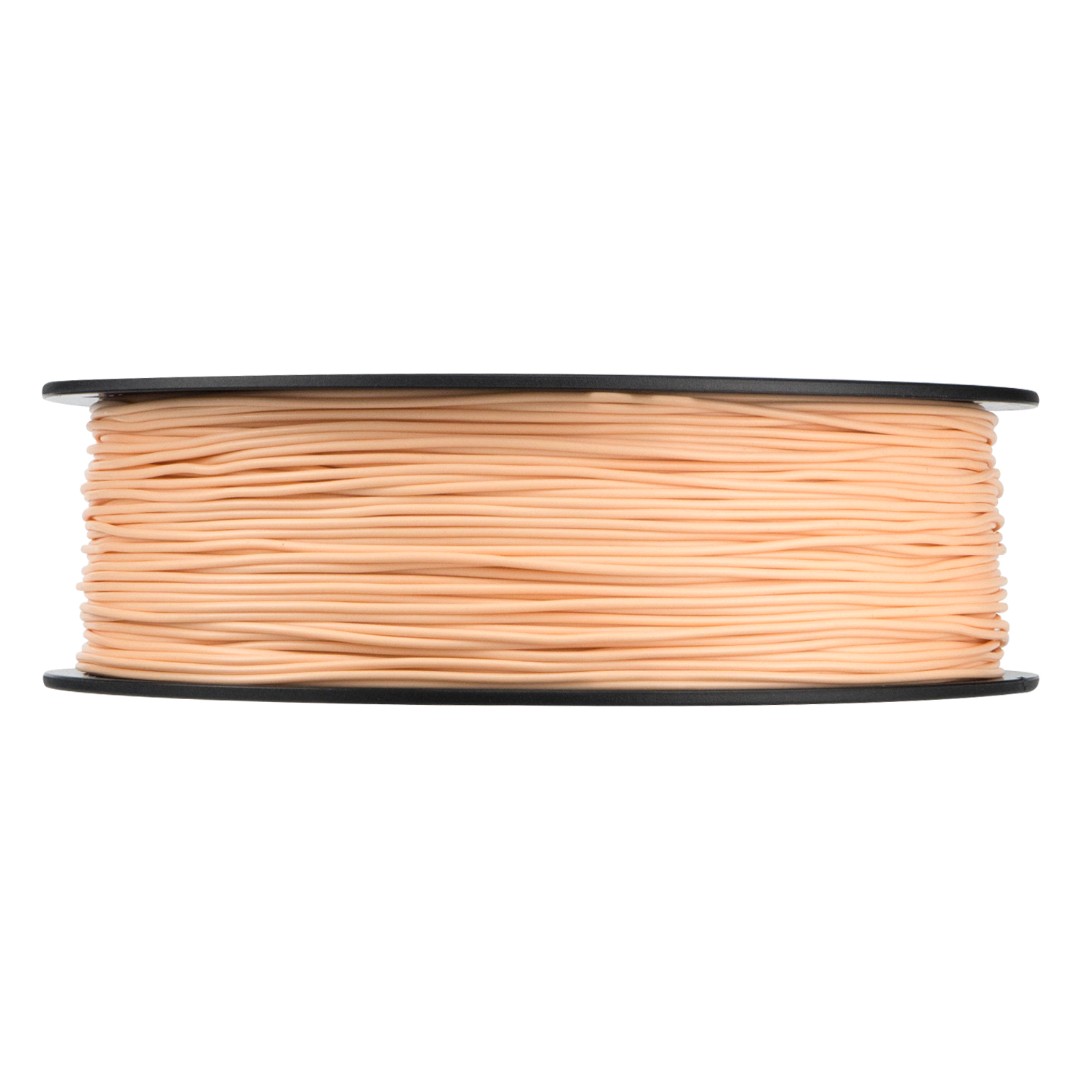
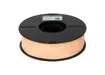
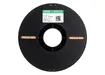
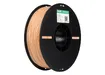
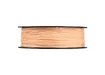
eSUN eLastic TPE-83A Buttery Salmon Soft Flexible TPE Filament 1 kg
eSUN TPE-83A Buttery Salmon is a soft flexible TPE filament for FDM/FFF 3D printing with Shore 83A hardness. It belongs to the eSUN eLastic line and is designed for elastic, soft, cushioning and pleasant-touch parts. Compared with TPU-87A and TPU-95A, TPE-83A is softer and more rubber-like, making it suitable for cases, straps, wristbands, insoles, dampers, gaskets, soft pads, sporting accessories and flexible decorative-functional parts.
Buttery Salmon is a warm salmon-beige shade. It is useful for wearable products, wristbands, straps, soft accessories, decorative elements, consumer product prototypes and parts where a softer visual appearance is preferred over technical black or white. The material provides a matte surface, pleasant soft touch, high elasticity and good impact resistance.
✅ Key advantages
- Shore 83A softness: softer than TPU-87A and TPU-95A, making it better for rubber-like parts.
- High flexibility: printed parts can bend, compress and return to shape.
- Pleasant soft touch: suitable for wearable products, wristbands, straps and soft pads.
- Matte surface: printed parts have a soft visual appearance without strong gloss.
- Impact resistance: a good option for dampers, protective elements and cushioning inserts.
- Buttery Salmon color: a warm salmon-beige shade for accessories, prototypes, straps, wristbands and decorative soft parts.
- Bending resistance: suitable for parts that are regularly deformed.
- Functional use: can be used not only for decorative models but also for working soft components.
📐 Technical specifications
| Property | Value |
|---|---|
| Brand | eSUN |
| Line | eLastic |
| Material | TPE-83A |
| Material type | Soft flexible TPE filament |
| Color | Buttery Salmon |
| Color description | Warm salmon-beige shade |
| Hardness | Shore 83A |
| Diameter | 1.75 mm |
| Net weight | 1 kg |
| Print technology | FDM / FFF |
| Surface | Matte, soft-touch |
| Recommended feeding system | Direct Drive / short filament path |
| Bowden / remote extruder | Not recommended |
| Main applications | Wristbands, straps, soft accessories, cases, insoles, dampers, gaskets, soft pads, decorative-functional parts |
📊 Physical and mechanical properties
| Property | Value |
|---|---|
| Density according to TDS | 1.14 g/cm³ |
| Tensile strength | 32 MPa |
| Elongation at break | 420% |
| Melt flow index | N/A |
| Flexural strength | N/A |
| Flexural modulus | N/A |
| IZOD impact strength | N/A |
| Heat deflection temperature | N/A |
| Material behavior | Soft, flexible, elastic, impact-resistant, rubber-like |
⚙️ Recommended Printing Parameters
| Parameter | Recommended value |
|---|---|
| Drying before printing | 55 ℃ for more than 4 hours |
| Nozzle temperature | 220–250 ℃ |
| Bed temperature | 45–60 ℃ |
| Printing speed | 20–50 mm/s |
| Recommended starting speed | 20–30 mm/s for first tests |
| Fan speed | 100% |
| Retraction | Minimal, tune by testing |
| Recommended extruder | Direct Drive / short filament path |
| Build surface | PEI, textured PEI sheet, glass with adhesive or another TPE/TPU-compatible surface |
🔧 Printing recommendations
- Dry the filament at 55 ℃ for more than 4 hours before printing.
- Use a Direct Drive extruder or the shortest possible filament path.
- A long Bowden path is not recommended: soft TPE can compress, bend and feed inconsistently.
- For first tests, start at 20–30 mm/s.
- Minimize retraction to avoid stretching and compression of the soft filament in the feeding path.
- Do not overtighten the extruder gear: excessive pressure can deform the filament.
- Avoid sharp bends between the spool and the extruder.
- Use a filament dry box or eBOX during long print jobs.
- If bubbles, popping, stringing, haze or unstable extrusion appear, dry the material again.
- After long print jobs, cleaning filament can be used to clean the nozzle.
🧩 Best applications
- ⌚ Watch straps, wristbands, wearable accessories and soft mounts.
- 📱 Soft cases for phones, cameras, remote controls and electronics.
- 👟 Insoles, shoe inserts, soft sole elements and cushioning parts.
- 🛡️ Dampers, buffers, protective pads and shock-absorbing inserts.
- 🏃 Sporting accessories, knee pads, pads and soft equipment elements.
- 🎨 Decorative soft elements, consumer product prototypes and warm-tone accessories.
- 🔩 Gaskets, seals, vibration-isolating elements and soft technical parts.
- 🧪 Prototypes for testing softness, flexibility, fit, compression and cushioning.
✅ 3D printer compatibility
eSUN TPE-83A Buttery Salmon is compatible with FDM/FFF 3D printers using 1.75 mm filament and supporting a 220–250 ℃ nozzle temperature range. It can be printed on Bambu Lab, Creality, Prusa, Anycubic, Elegoo, Sovol, QIDI, Flashforge and other 3D printers when soft flexible filament feeding is properly tuned.
For TPE-83A, Direct Drive extruders are preferred. Bowden systems or remote extruders are not recommended because soft Shore 83A material is difficult to push reliably through a long tube. Stable results require a short filament path, low speed, minimal retraction, correct extruder gear pressure and dry filament.
📦 Storage and preparation
- Store the filament in a cool, dry place.
- After opening, keep the spool in a sealed bag or container with desiccant.
- Before important prints, dry the material at 55 ℃ for more than 4 hours.
- For long print jobs, using a filament dry box is recommended.
- Do not leave the spool in a humid room for a long time.
📄 File Download: technical files and certificates
- Parameters for Bambu Lab & Creality — starting print settings for popular 3D printers.
- TDS — technical data sheet.
- MSDS/SDS — material safety data sheet.
- RoHS — restricted substances report.
- REACH — SVHC report.
🛡️ Safety and certification
TPE-83A is not classified as a hazardous chemical under GHS, but standard safety measures should be followed during printing and post-processing. Print in a well-ventilated area, avoid overheating, open flames, sparks and hot surfaces. During mechanical processing of printed parts, safety glasses and a mask are recommended if dust is generated.
According to official eSUN documentation, TDS, MSDS/SDS, RoHS and REACH files are available for TPE-83A. Certificates and reports confirm tested samples, but they are not a universal guarantee for every finished part, especially if the part is used in skin-contact, children’s products, food-contact applications or special technical conditions.
❓ FAQ
The better official commercial name is Buttery Salmon. It can be described as a warm salmon-beige shade. Yes. TPE-83A has Shore 83A hardness, so it is softer and more rubber-like than TPU-87A Shore 87A. TPU-95A is harder, easier to print and better suited for denser functional parts. TPE-83A is softer, more elastic and better for parts requiring soft touch and cushioning behavior. It is not recommended. TPE-83A prints better with Direct Drive or the shortest possible filament path because soft filament may compress and feed inconsistently in a long tube. Yes. Drying at 55 ℃ for more than 4 hours before printing is recommended. Dry material prints more consistently and produces fewer bubbles and strings. Buttery Salmon TPE-83A is suitable for wristbands, straps, soft accessories, decorative flexible parts, consumer product prototypes, soft cases, insoles, dampers and parts where a warm visual shade is preferred. TPE-83A is harder to print than PLA, PETG and stiffer TPU materials. For first experience with flexible filaments, a Direct Drive printer and low speed around 20–30 mm/s are recommended.Is the correct color name Butter Salmon or Buttery Salmon?
Is TPE-83A softer than TPU-87A?
How is TPE-83A different from TPU-95A?
Can TPE-83A be printed on a Bowden printer?
Does TPE-83A need drying?
What is Buttery Salmon TPE-83A best for?
Is TPE-83A suitable for beginners?
🚀 Why buy
eSUN TPE-83A Buttery Salmon is a strong choice for printing soft, flexible and rubber-like parts in a warm salmon-beige shade. It is suitable for products that should feel pleasant to touch, absorb impact, bend and return to shape. The Buttery Salmon color is especially useful for wristbands, straps, soft accessories, decorative elements, consumer product prototypes and functional parts where both material behavior and appearance matter.