


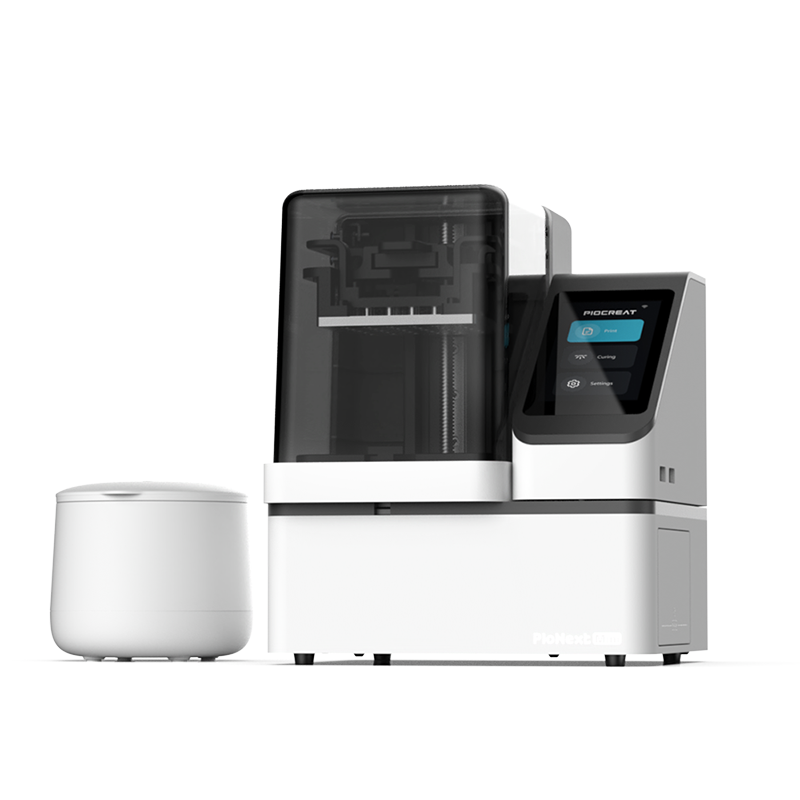
PioNext Mini All-in-One Dental 3D Printer
PioNext Mini is a compact all-in-one dental LCD 3D printer that combines precise 3D printing and integrated final curing in one device. It is designed for dental clinics, chairside workflows and dental laboratories where speed, consistency, compact size and workflow efficiency matter.
The printer is suitable for daily chairside use: it has a small footprint, supports dental photopolymer materials, works with 385 nm and 405 nm wavelengths, features a 9K LCD screen and provides 18 μm XY accuracy. With integrated curing, PioNext Mini helps reduce the amount of separate equipment on the workstation and makes the production process more organized and efficient.
⭐ Key Advantages
- 🦷 All-in-one workflow: printing and curing in one compact device.
- ⚡ Fast printing: the manufacturer states ceramic crown fabrication in as little as around 10 minutes under standard conditions.
- 🔬 9K LCD screen: 8520 × 4320 resolution for highly detailed dental models and restorations.
- 🎯 18 μm XY accuracy: fine pixel size helps reproduce thin margins, contact areas and small details.
- 💡 Dual wavelength: 385 nm and 405 nm support expands compatibility with dental resins.
- 🌡️ Heated chamber: the working environment can reach up to 35 °C for better resin flow and smoother layers.
- 🧪 Dual resin vats: PioNext Mini comes standard with two resin vats for convenient work with different materials.
- ✅ Leveling-free design: four-point alignment simplifies preparation before printing.
- 📡 USB and WiFi: convenient file transfer in a clinic or lab environment.
- 🧩 PioCreat Box / CHITUBOX Dental: supported slicing software for dental model preparation.
📌 Product Description
PioNext Mini is designed for dentists and dental technicians who need a compact, accurate and easy-to-use 3D printer for producing dental parts from photopolymer resins. Unlike a standard LCD printer, this model integrates printing and curing into one device, making the workflow more compact: less equipment on the desk, fewer transfers between devices and a cleaner working area.
The build volume of 80 × 70 × 80 mm is suitable for small dental parts, single restorations, models, aligner-related work, splints and other applications where accuracy, repeatability and production speed are important. With a machine size of 200 × 170 × 241 mm, the unit can be placed easily in a dental office or small lab without requiring a large dedicated area.
Support for 385 nm and 405 nm wavelengths gives more flexibility when choosing materials. This is important in dentistry because different resins may require different exposure and post-processing settings. For consistent results, always use a validated resin profile, perform exposure testing and follow the material manufacturer’s instructions.
⚙️ Technical Specifications
| Parameter | Value |
|---|---|
| Model | PioNext Mini |
| Device Type | Dental LCD 3D printer with integrated curing |
| Printing Technology | LCD |
| Printing Size | 80 × 70 × 80 mm |
| Machine Size | 200 × 170 × 241 mm |
| Package Size | 310 × 307 × 340 mm |
| Curing Size | 76.5 × 72.5 × 37 mm |
| Curing Light Intensity | 150 mW/cm², 405 nm |
| Light Source Wavelength | 385 nm / 405 nm |
| XY Axis Accuracy | 18 μm |
| Screen Resolution | 9K, 8520 × 4320 |
| Maximum Print Speed | up to 60 mm/h |
| Layer Thickness | 0.01–0.1 mm |
| Touch Screen | 3.97″ capacitive color touch screen |
| Data Transmission | USB / WiFi |
| Slicer Software | PioCreat Box / CHITUBOX Dental |
| Input Voltage | 100–240V, 50/60Hz |
| Power | 120W |
| Manufacturer Warranty | 12 months |
| SKU | To be confirmed |
🦷 Dental Applications
- removable dentures;
- veneers, crowns and inlays;
- orthodontic models;
- crystal-clear retainers;
- splints and night guards;
- dental models for diagnostics and treatment planning;
- chairside production in a dental office;
- small lab tasks where accuracy and short turnaround time are important.
🧪 Material Compatibility
PioNext Mini is designed to work with dental photopolymer resins suitable for LCD printing and compatible with 385 nm or 405 nm wavelengths. It can be used with dental resins for models, orthodontic applications, retainers, splints, temporary restorations and other dental workflows when the correct print profile and post-processing protocol are used.
Important: the biocompatibility of a finished dental part depends not only on the printer, but primarily on the selected resin, its certification, exposure accuracy, washing quality, drying and final curing. For medical and dental parts, use only materials intended for the specific clinical application.
💡 Printing and Integrated Curing
The main feature of PioNext Mini is that it combines printing and curing in one device. After printing, the part can be processed in the integrated curing area, which is especially convenient for small clinics and dental offices where there may not be enough space for a separate curing station.
The curing area measures 76.5 × 72.5 × 37 mm, and the curing light intensity is 150 mW/cm² at 405 nm. This makes the machine convenient for small dental parts, but the exact post-processing settings should always follow the resin manufacturer’s instructions.
🌡️ Heated Chamber
The working environment can heat up to 35 °C, helping improve resin flow. This is especially useful when working with more viscous dental materials: stable temperature can support more consistent layer formation, reduce the risk of defects and help produce a smoother surface.
✅ Workflow Convenience
- Intuitive operation: the 3.97″ color touch screen makes task selection and print control easier.
- Leveling-free design: four-point alignment reduces manual setup work.
- Two resin vats: convenient for working with different materials without constantly changing one vat.
- Compact body: suitable for a dental office, clinic or small laboratory.
- USB/WiFi transfer: a convenient workflow with fewer file-handling steps.
📄 File Download: technical files and certificates
- Brochure / PioNext Mini product brochure.
- User Manual — when available from the supplier or manufacturer.
- Software: PioCreat Box / CHITUBOX Dental.
- Print profiles for compatible dental resins — to be selected according to the exact material.
🧰 Accessories and Consumables
- Release Film — film for the resin vat.
- Resin Vat — replacement resin vat.
- Build Platform — printing platform.
- Dental resin — dental photopolymer resins for 385/405 nm.
⚙️ Recommended Starting Print Settings
For PioNext Mini, print settings depend on the exact dental resin, wavelength, layer height, temperature, material color and the requirements of the final part. Before production printing, perform exposure testing and use the profile recommended by the resin manufacturer.
| Parameter | Starting Recommendation |
|---|---|
| Layer Height | 0.05 mm for a balance of speed and detail |
| Fine Detail | 0.025–0.03 mm when maximum accuracy is required |
| Wavelength | 385 nm or 405 nm according to the material profile |
| Working Temperature | stable temperature, heated up to 35 °C when needed |
| Exposure | only according to the calibrated profile of the exact resin |
| Post-processing | washing, drying and curing strictly according to resin instructions |
🧼 Workflow Recommendations
- Mix the dental resin thoroughly before printing according to the manufacturer’s instructions.
- Use a clean vat, intact release film and calibrated print profile.
- Do not mix different resins unless the material manufacturer recommends it.
- After printing, wash the model thoroughly with a suitable cleaning agent.
- Dry the part completely before final curing.
- For clinical parts, follow the full post-processing protocol specified in the documentation for the biocompatible resin.
- Wear gloves, eye protection and work in a well-ventilated area.
🏥 Why Choose PioNext Mini
PioNext Mini is a strong choice for dental clinics and small laboratories that need a compact and fast 3D printer for daily work. It combines several important advantages: 9K resolution, 18 μm XY accuracy, 385/405 nm wavelength support, integrated curing, two resin vats, a heated chamber and convenient USB/WiFi file transfer.
For dentists, this means a shorter path from digital model to finished part. For laboratories, it offers a compact additional solution for small and urgent jobs. For chairside workflows, it can help produce models, retainers, splints and other dental parts faster without installing a large set of separate equipment.
❓ FAQ
PioNext Mini is designed specifically for dental applications and combines printing with integrated curing. It also supports 385 nm and 405 nm wavelengths, has a compact body, a 9K LCD screen and 18 μm XY accuracy. Yes. The model is designed for compact chairside use. It takes up little space and is suitable for daily dental tasks when appropriate dental resins and correct post-processing procedures are used. The printer can be used for such tasks when paired with the appropriate dental resins. It is important to use a material specifically intended for the required application and to follow its clinical protocol. Dental photopolymer resins compatible with LCD printing and 385 nm or 405 nm wavelengths are suitable. Always check the material profile and the resin manufacturer’s recommendations before printing. PioNext Mini includes an integrated curing area, so for small parts a separate curing station may not be required. However, this depends on the part size, resin type and post-processing requirements. Different dental resins may be designed for different wavelengths. Support for both 385 nm and 405 nm expands material choice and helps match the correct printing profile. It refers to the pixel size/accuracy in the XY plane. A smaller value allows higher potential detail when exposure, resin quality and post-processing are properly controlled. Technically, the printer is designed for photopolymer materials with compatible wavelengths, but dental parts should only be produced with specialized dental resins that have the required certification and intended use.How is PioNext Mini different from a standard LCD 3D printer?
Can PioNext Mini be used in a dental office?
Is PioNext Mini suitable for crowns and temporary restorations?
Which resins are compatible with PioNext Mini?
Do I need a separate curing station?
Why are 385 nm and 405 nm wavelengths important?
What does 18 μm XY accuracy mean?
Can non-dental resins be used with PioNext Mini?