


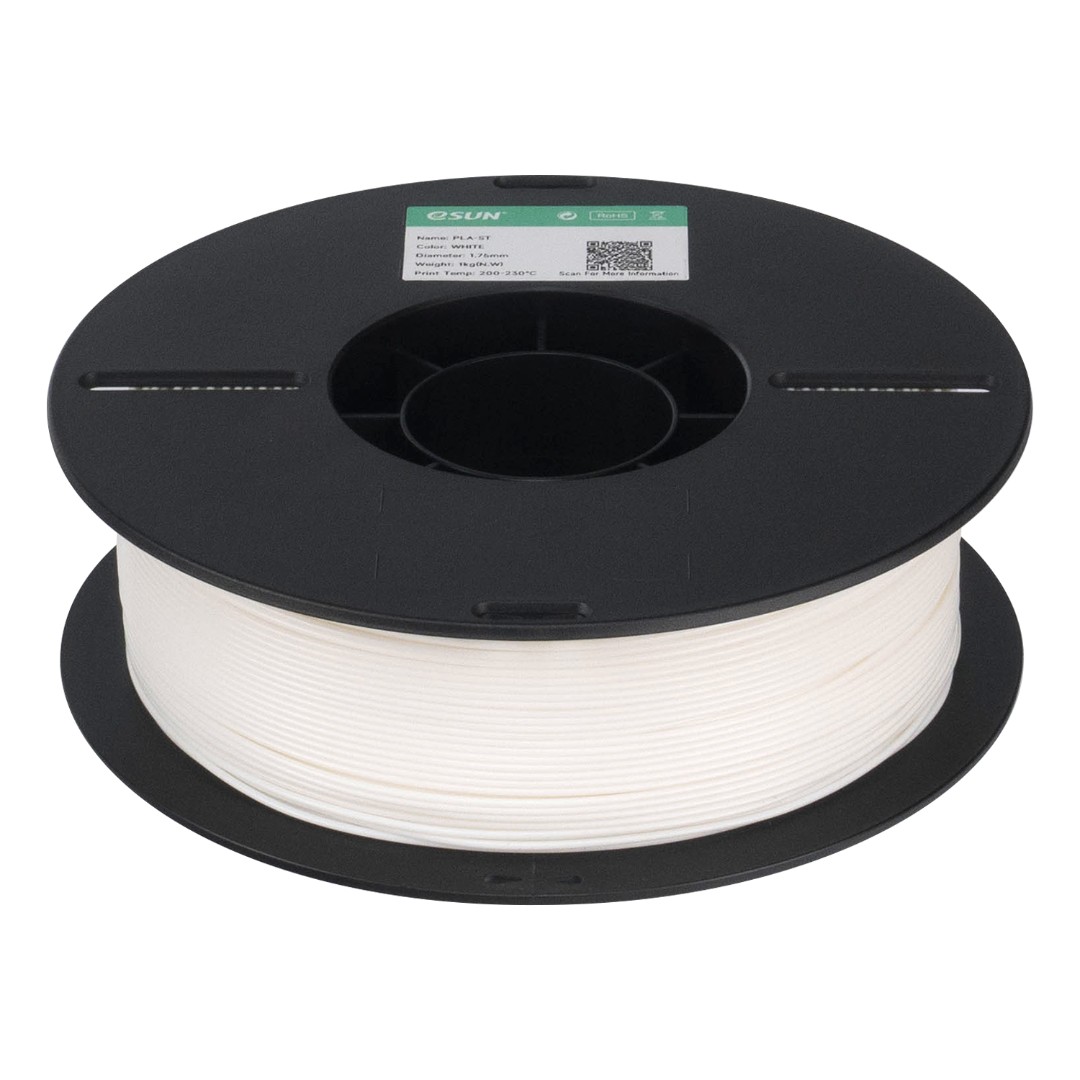
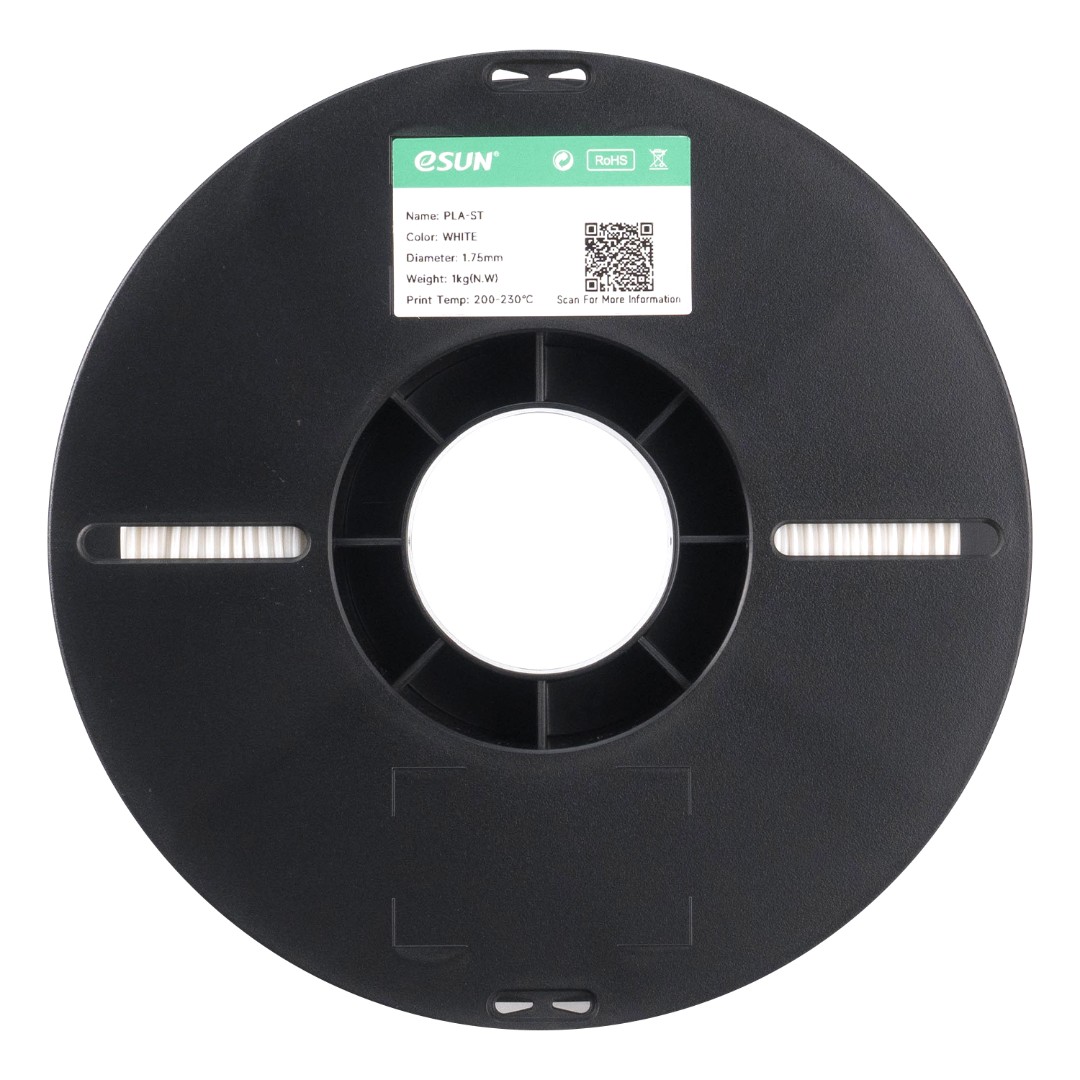
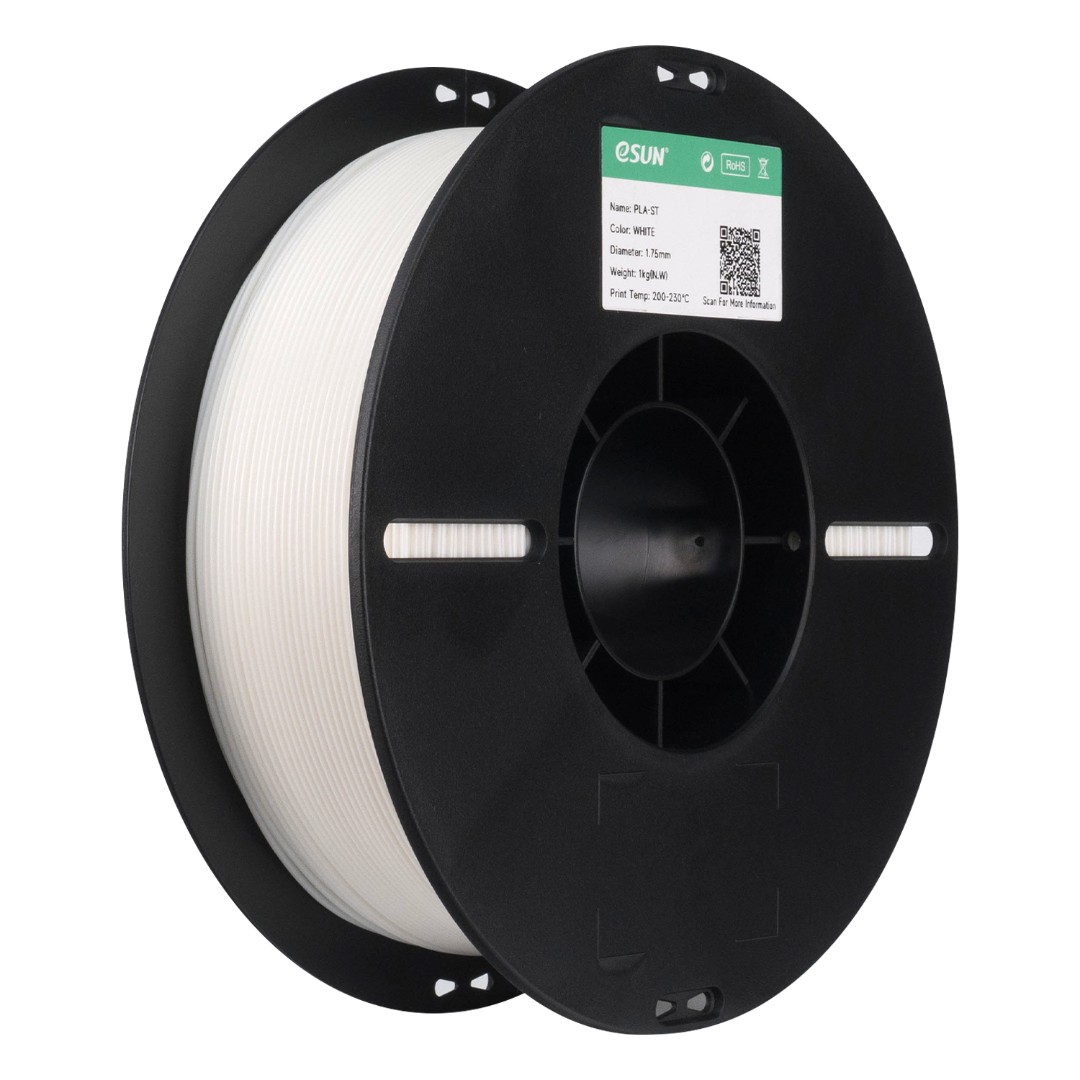
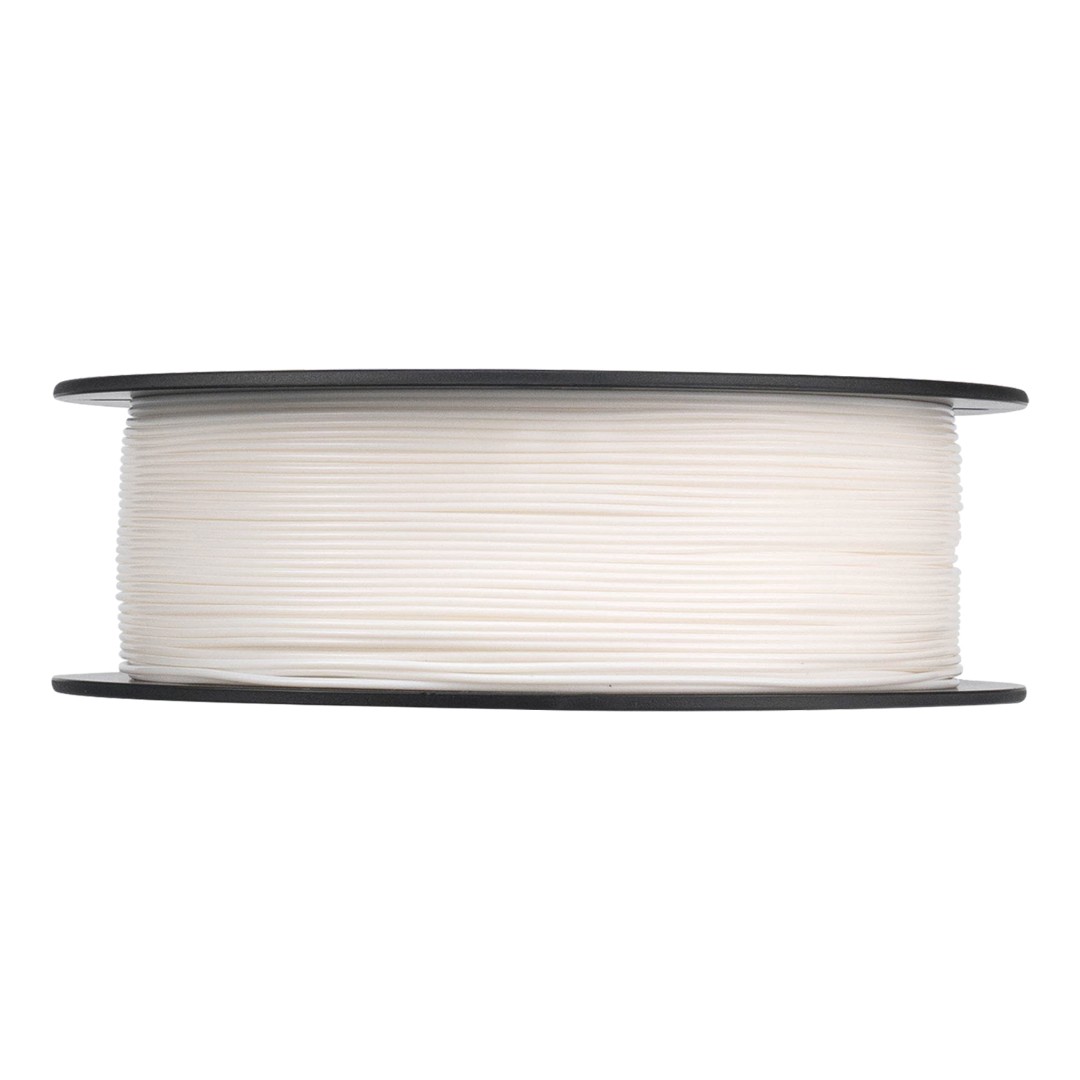
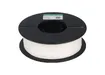
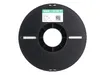
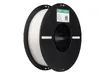
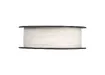
eSUN PLA-ST White Filament 1 kg with Plastic Roll
eSUN PLA-ST White is a white Super Tough PLA filament for FDM/FFF 3D printing, developed for strong functional parts, engineering prototypes, housings, brackets, mechanical components, test samples, presentation models and paintable prints. The material combines PLA-like printability with higher impact resistance, improved ductility, stable feeding and clean surface quality.
Important package detail: this eSUN PLA-ST White version is specified with plastic roll, not cardboard roll. A plastic roll is convenient for stable feeding, storage, drying, spool holders and dry box use.
✅ Main advantages
- White color: a universal light base for prototypes, housings, test parts, presentation models and paintable prints.
- Super Tough PLA: more impact-resistant and less brittle than regular PLA.
- High elongation at break: printed parts better tolerate deformation, bending and moderate loads.
- Good layer bonding: helps produce more reliable functional parts.
- High printing accuracy: suitable for fit-critical parts, fasteners, housings and engineering prototypes.
- Low warping: easier to print than many engineering plastics and usually does not require an enclosed chamber.
- Stable feeding: neat winding and stable diameter help reduce clogging risk.
- Plastic roll: practical for storage, repeated use and printing from a dry box.
📐 Technical specifications
| Property | Value |
|---|---|
| Brand | eSUN |
| Material | PLA-ST / ePLA-ST, Super Tough PLA |
| Color | White |
| Filament diameter | 1.75 mm |
| Net weight | 1 kg |
| Spool type | Plastic roll, not cardboard roll |
| Print technology | FDM / FFF |
| Main use | Functional parts, housings, brackets, prototypes, mechanical models and paintable parts |
📊 Physical and mechanical properties
| Property | Value |
|---|---|
| Density | 1.25 g/cm³ |
| Melt flow index | 3.2 g/10 min at 190 ℃ / 2.16 kg |
| Tensile strength | 34.3 MPa according to TDS |
| Elongation at break | 90% according to TDS |
| Flexural strength | 43 MPa according to TDS |
| Flexural modulus | 1477 MPa according to TDS |
| IZOD impact strength | 63 kJ/m² according to TDS |
| Heat distortion temperature | 52 ℃ at 0.45 MPa |
⚙️ Recommended Printing Parameters
| Parameter | Recommended value |
|---|---|
| Nozzle temperature | 200–230 ℃ |
| Bed temperature | 45–60 ℃ |
| Printing speed | 40–100 mm/s; for functional parts, start around 40–80 mm/s |
| Maximum speed after profile tuning | up to <200 mm/s |
| Fan speed | 100% |
| Heated bed | Recommended |
| Recommended speed for remote printing | ≤40 mm/s to reduce potential feeding issues |
🔧 Tuning recommendations
- For the first profile, start with 210–220 ℃ nozzle temperature and 50–60 ℃ bed temperature.
- For maximum layer bonding, increase temperature gradually and monitor surface quality.
- Do not print functional parts too cold because layer adhesion may become weaker.
- For housings, brackets and mechanical parts, use 4 or more walls.
- For loaded parts, increase infill to 20–40% or higher depending on the application.
- If stringing or blobs appear, reduce temperature or tune retraction.
- For holes, snap fits and fit-critical areas, print a test sample before production.
- White color is convenient for priming, painting, marking and visual surface inspection.
🧩 Best applications
- ⚙️ Functional parts and engineering prototypes.
- 🔩 Brackets, holders, mounts and fixture components.
- 📦 Housings, covers, lids and technical panels.
- 🔌 Parts for electronics, devices and working mockups.
- 🚗 Automotive mockups, interior parts and fit-test components.
- 🛠️ Mechanical models with higher impact-resistance requirements.
- 📐 Parts where dimensional accuracy, stable geometry and clean surface quality matter.
- 🎨 White prints for painting, priming, presentation and decorative finishing.
✅ 3D printer compatibility
eSUN PLA-ST White is compatible with most FDM/FFF 3D printers that use 1.75 mm filament and support a 200–230 ℃ nozzle temperature range. It can be used with Creality Ender/K1, Bambu Lab A1/P1/X1, Prusa MK/XL/MINI, Anycubic Kobra, Elegoo Neptune, Sovol, QIDI, Flashforge and other popular 3D printers.
An enclosed chamber is usually not required, but for large functional parts it is better to avoid drafts and sudden temperature changes. For stable geometry, use a heated bed, a clean build surface and a properly tuned first layer.
📦 Storage and drying
- Store the filament in a dry place, preferably in a sealed bag or dry box with desiccant.
- After opening, do not leave the spool exposed in a humid room for a long time.
- The plastic roll is convenient for repeated storage, drying and spool holder use.
- If bubbles, popping, unstable extrusion or excessive strings appear, dry the filament before printing.
- For long prints, using a dry box is recommended.
📄 File Download: technical files and certificates
- Parameters for Bambu Lab & Creality — printing parameters for popular printers.
- MSDS/SDS — material safety data sheet.
- TDS — technical data sheet with printing parameters and material properties.
- RoHS — restricted substances report.
- REACH — SVHC report.
🛡️ Safety
PLA-ST is not classified as a hazardous chemical according to SDS/GHS, but normal ventilation, avoiding overheating, careful handling around the hot nozzle and storage away from heat, sparks and open flames are still recommended during 3D printing.
❓ FAQ
No. PLA-ST is PLA-based, but it belongs to the Super Tough PLA category. It is designed for higher impact resistance, improved ductility and functional parts. This product card specifies eSUN PLA-ST White 1 kg with plastic roll, not cardboard roll. PLA+ is a universal improved PLA for everyday printing. PLA-ST is more focused on strong functional parts, mechanical prototypes and applications where higher impact resistance is required. In most cases, an enclosed chamber is not required. For larger parts, it is still better to avoid drafts and sudden temperature changes. Yes, but for functional parts it is better to start at 40–80 mm/s and increase speed only after testing. For remote printing, speed ≤40 mm/s is recommended. White PLA-ST is especially useful for engineering prototypes, housings, test parts, paintable models, presentation samples and prints that need a light base color.Is PLA-ST White the same as regular PLA?
Is the spool plastic or cardboard?
How is PLA-ST different from PLA+?
Does PLA-ST need an enclosed chamber?
Can PLA-ST be printed fast?
What is white PLA-ST best for?
🚀 Why buy
eSUN PLA-ST White 1 kg is a strong choice for printing durable engineering prototypes, functional parts, housings and paintable models where impact resistance, accuracy, stable geometry and clean surface quality matter. The white color is useful for visual inspection, marking, priming and painting, while the plastic roll makes the material convenient for storage and stable feeding.