


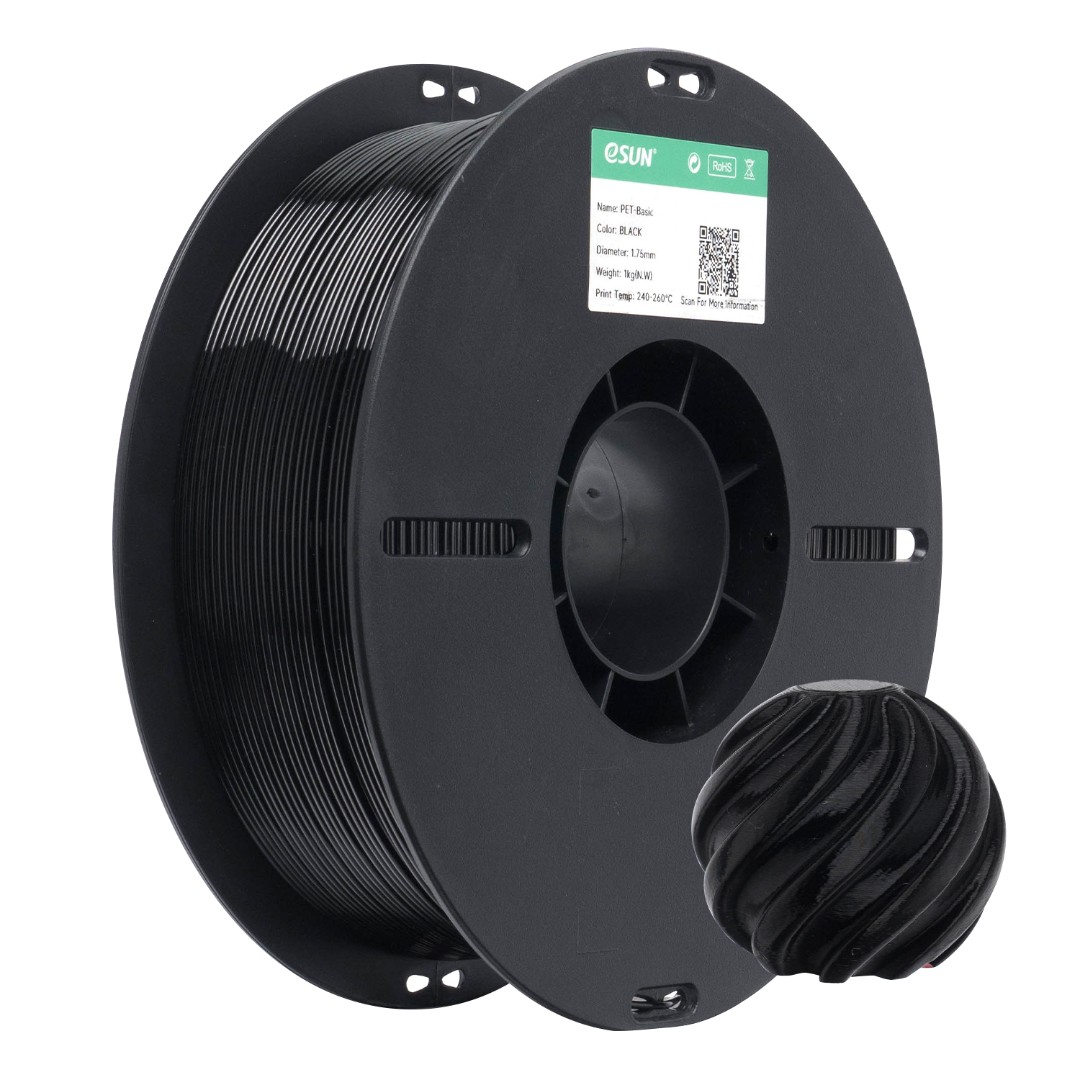
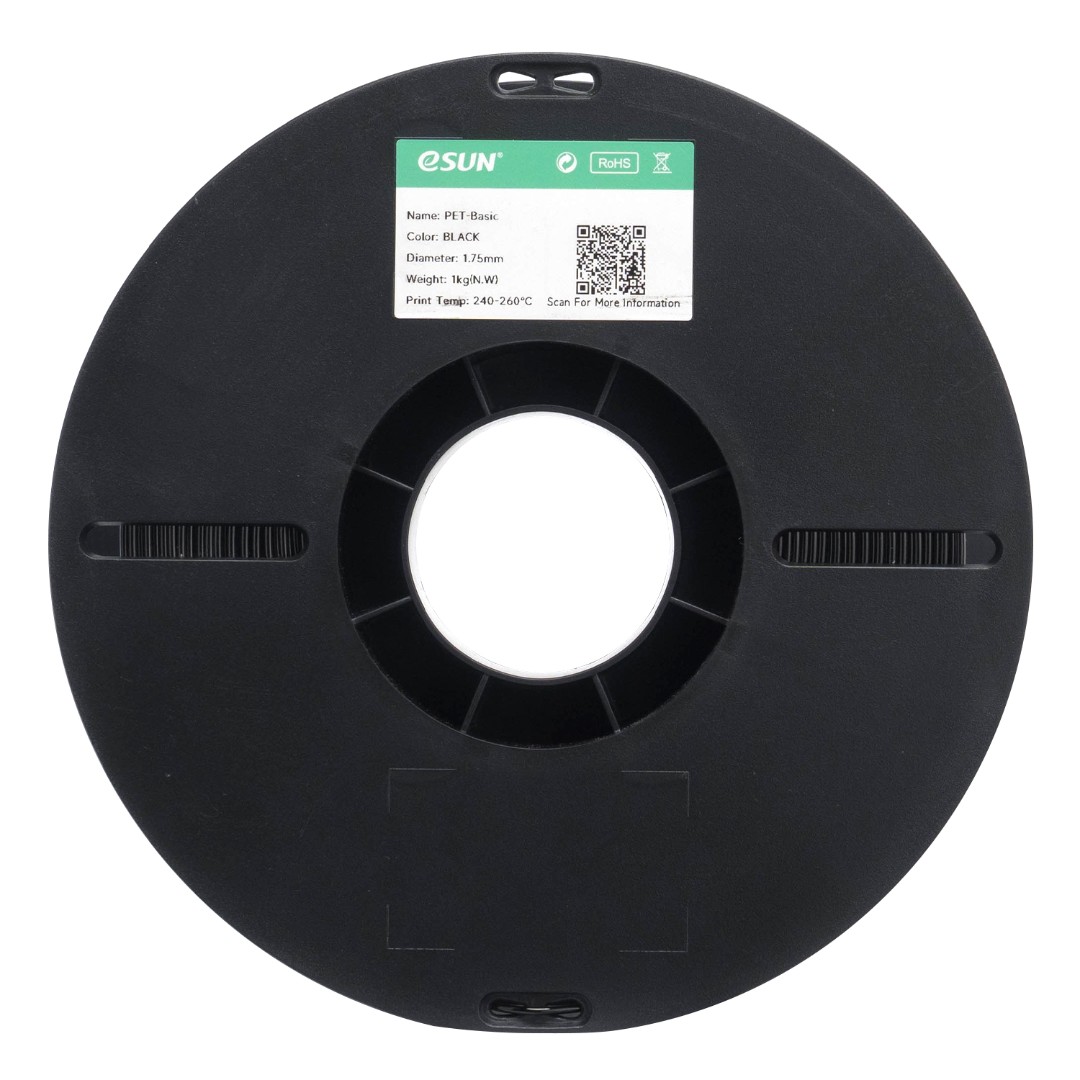
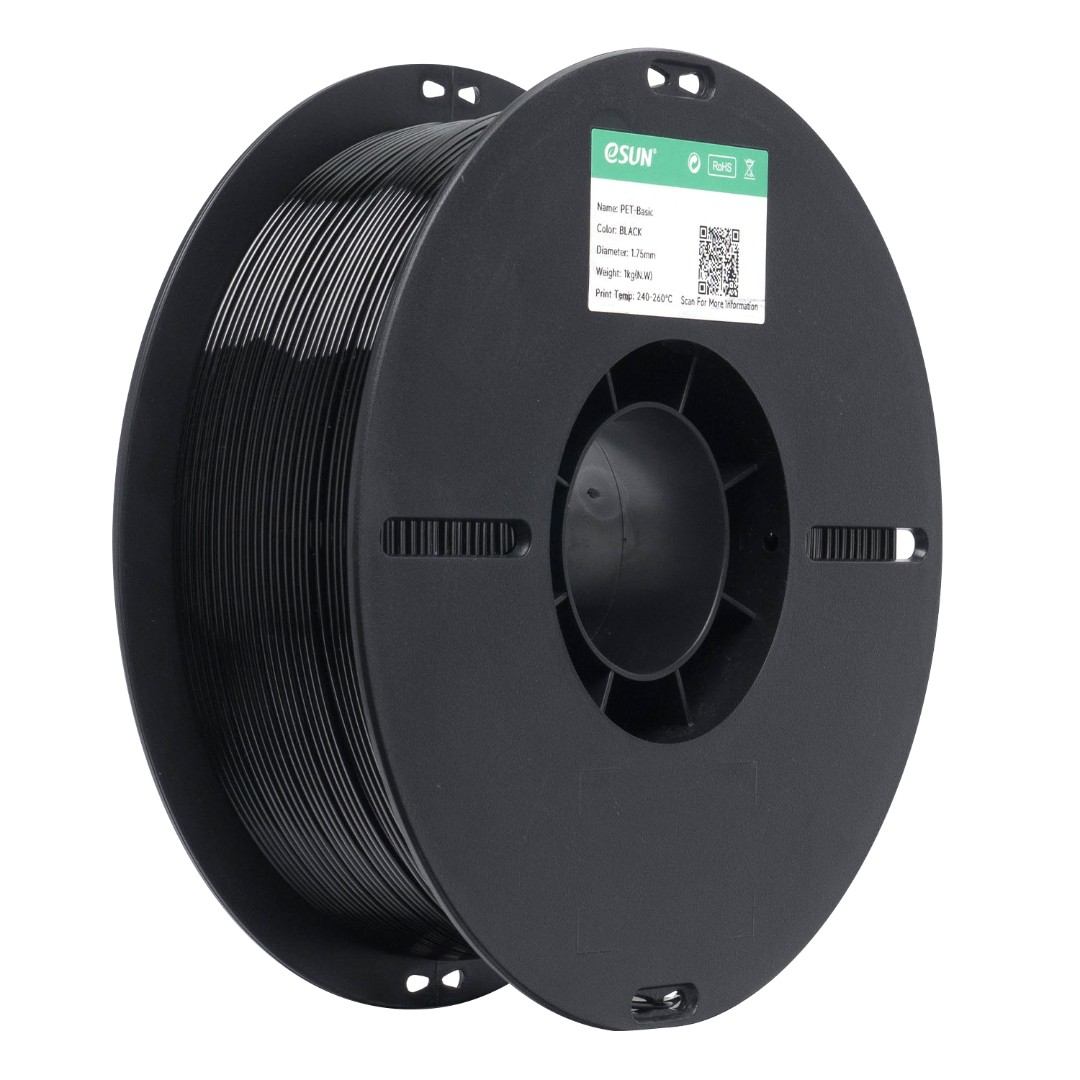
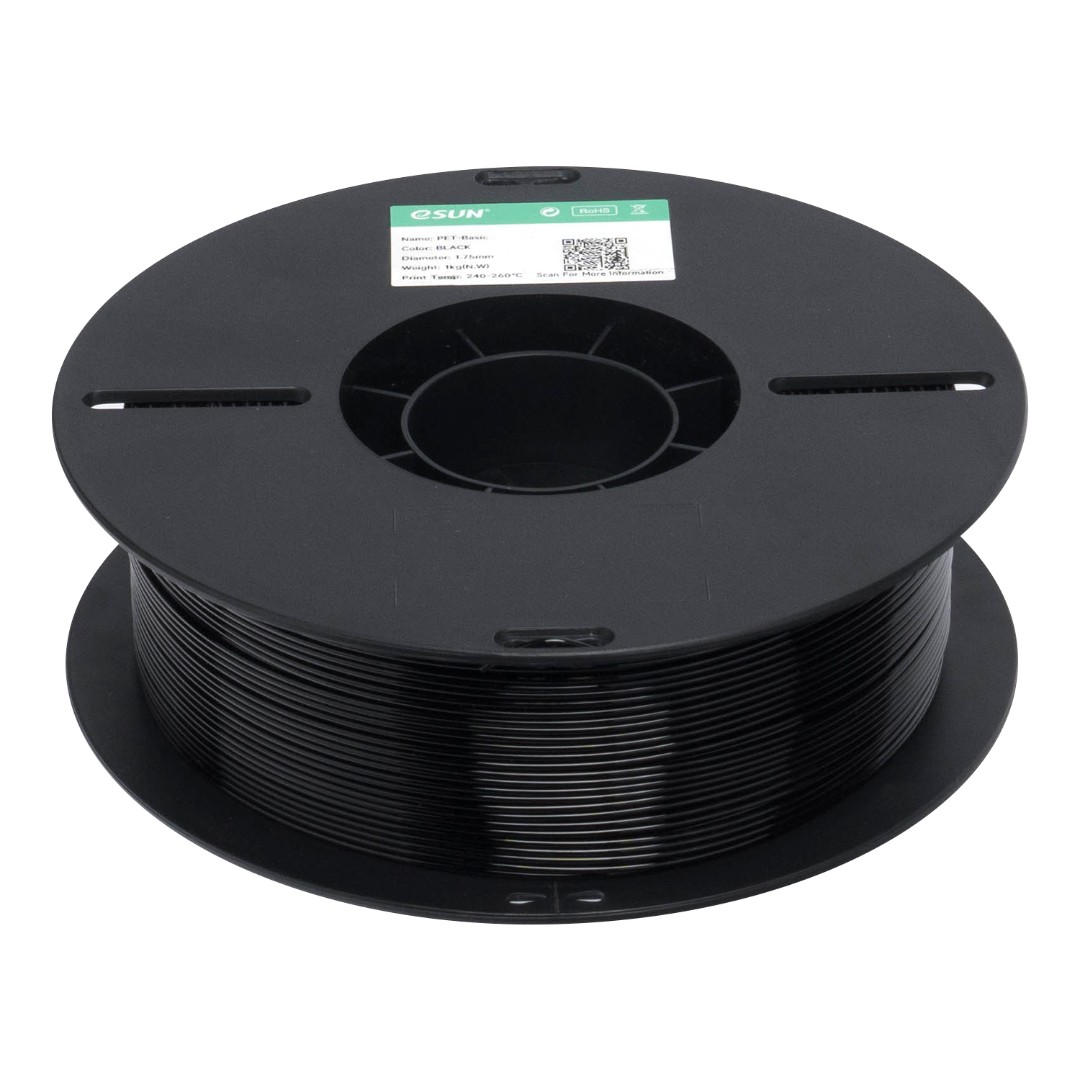
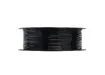
eSUN PET-CF Black Carbon Fiber Reinforced PET Filament 1 kg
eSUN PET-CF Black is a black engineering PET filament reinforced with carbon fiber for FDM/FFF 3D printing of rigid, strong, stable and heat-resistant parts. The material belongs to a more technical class of composite filaments and is designed for applications where standard PETG, PETG-CF, PLA or decorative materials no longer provide enough rigidity, temperature resistance and long-term stability.
The material is based on PET reinforced with short-cut carbon fiber. This gives PET-CF high rigidity, good dimensional stability, a matte carbon-fiber surface, improved wear resistance and a more professional appearance on printed parts. The black color makes the material universal for technical housings, brackets, automotive parts, industrial fixtures, tool fixtures and functional prototypes.
Unlike PETG-CF, PET-CF is designed for higher printing temperatures and more engineering-oriented use. After proper annealing, the material’s heat resistance can increase significantly, making it useful for parts that need to keep their shape at elevated temperatures.
✅ Key advantages
- PET reinforced with carbon fiber: high rigidity, stability and technical material behavior.
- Black engineering color: universal shade for housings, brackets, fixtures, automotive and industrial parts.
- High rigidity: suitable for functional parts where minimal flexibility is required.
- Improved heat resistance: after annealing, the material can withstand higher temperatures than standard PETG or PLA.
- Matte carbon-fiber surface: printed parts look clean, technical and professional.
- Reduced deformation during printing: carbon fiber helps reduce PET warping behavior.
- Wear resistance: useful for mounts, fixtures, installation parts and working components.
- Chemical resistance: suitable for a range of technical applications where environmental resistance is important.
- Low moisture absorption: more stable in humid conditions, but drying before printing is still required.
- 1.75 mm diameter: compatible with modern FDM/FFF 3D printers that support high-temperature printing.
📐 Technical specifications
| Property | Value |
|---|---|
| Brand | eSUN |
| Material | PET-CF |
| Material type | PET reinforced with carbon fiber |
| Color | Black |
| Diameter | 1.75 mm |
| Net weight | 1 kg |
| Surface | Matte, carbon-fiber, technical |
| Print technology | FDM / FFF |
| Recommended nozzle | Wear-resistant nozzle: hardened steel, ruby, tungsten carbide or another wear-resistant nozzle |
| Recommended hotend | All-metal hotend for stable long printing at high temperatures |
| Main applications | Housings, brackets, tool fixtures, jigs, automotive parts, industrial fixtures, aerospace prototypes, functional engineering parts |
📊 Physical and mechanical properties
| Property | Value |
|---|---|
| Density | 1.42 g/cm³ |
| Heat deflection temperature | 75 ℃ at 0.45 MPa |
| Heat deflection temperature after annealing | 145 ℃ at 0.45 MPa |
| Glass transition temperature | 70 ℃ |
| Tensile strength XY | 80.32 MPa |
| Tensile strength Z | 22 MPa |
| Elongation at break XY | 3.61% |
| Elongation at break Z | 2.11% |
| Flexural strength XY | 135.6 MPa |
| Flexural strength Z | 33.4 MPa |
| Flexural modulus XY | 8264.15 MPa |
| Flexural modulus Z | 2165.01 MPa |
| IZOD impact strength XY | 7.16 kJ/m² |
| IZOD impact strength Z | 2.12 kJ/m² |
⚙️ Recommended Printing Parameters
| Parameter | Recommended value |
|---|---|
| Drying before printing | 80 ℃ for more than 8 hours or 80–100 ℃ for 4–8 hours |
| Nozzle temperature | 250–300 ℃ |
| Extended nozzle temperature range | 250–320 ℃ if the hotend is rated for this temperature |
| Bed temperature | 70–120 ℃ |
| Fan speed | 0–20% |
| Print speed | Up to 200 mm/s after profile tuning |
| Recommended starting speed | 40–80 mm/s for functional parts |
| Nozzle | 0.4–1.0 mm, wear-resistant |
| Dry box printing | Recommended |
| Enclosure | Not required, but stable temperature helps with large parts |
🔧 Printing recommendations
- Dry the filament at 80 ℃ for more than 8 hours before printing.
- For long print jobs, use a dry box or sealed filament container.
- Use a wear-resistant nozzle: hardened steel, ruby, tungsten carbide or another wear-resistant nozzle.
- Do not use a standard brass nozzle for regular printing: carbon fiber quickly wears brass.
- For stable high-temperature printing, an all-metal hotend is recommended.
- Start at 40–80 mm/s, especially for functional and accurate parts.
- For rigid parts, use enough walls and an appropriate infill pattern.
- Reduce outer wall speed when a cleaner matte surface is required.
- Use Z seam alignment and choose the seam position for a cleaner appearance.
- Disable Z-hop / Z-lift if it leaves marks on the surface.
- Avoid travel moves across outer walls.
- After printing, let the part cool on the bed to reduce deformation risk.
- For higher heat resistance, test annealing and check dimensional changes.
🧩 Best applications
- ⚙️ Functional engineering parts.
- 🔩 Brackets, fixtures, holders, mounts and installation elements.
- 🏭 Industrial jigs, fixtures and tool fixtures.
- 🚗 Automotive parts, prototypes and technical inserts.
- ✈️ Aerospace prototypes and lightweight rigid components.
- 🧩 Parts for 3D printers, machines and equipment.
- 📦 Electronic housings, covers, panels and protective elements.
- 🧪 Functional prototypes for checking shape, fit, rigidity and heat resistance.
- 🛠️ Working parts where standard PETG is not rigid enough or not heat-resistant enough.
- ⚫ Black technical parts with a matte carbon-fiber surface.
✅ 3D printer compatibility
eSUN PET-CF Black is compatible with FDM/FFF 3D printers using 1.75 mm filament, supporting a 250–300 ℃ nozzle temperature range and a 70–120 ℃ heated bed. Stable printing also requires dry material, a wear-resistant nozzle and a properly tuned profile.
The material can be printed on Bambu Lab, Creality, Prusa, Anycubic, Elegoo, QIDI, Flashforge, Raise3D, Voron and other FDM/FFF printers if the printer supports the required hotend temperature and stable feeding of composite filament. For hotends with PTFE tubing, check the allowed temperature carefully: for long PET-CF printing, an all-metal hotend is recommended.
PET-CF vs PETG-CF
| Material | Feature | When to choose |
|---|---|---|
| PET-CF | PET reinforced with carbon fiber; higher rigidity, heat resistance and engineering focus | For heat-resistant functional parts, industrial fixtures, tool fixtures and technical components |
| PETG-CF | PETG with carbon fiber; lower temperature profile and easier printing | For technical housings, brackets and functional prototypes without higher heat resistance requirements |
Heat resistance and annealing
The base heat deflection temperature of PET-CF is 75 ℃ at 0.45 MPa. After proper annealing, this value can reach 145 ℃ at 0.45 MPa. This makes the material suitable for parts that require higher heat resistance compared with standard PETG or PLA.
Annealing can affect part geometry, so before using it for critical parts, it is recommended to test the heat treatment process on a small model. Shrinkage, dimensional changes, fitting holes and shape accuracy should be checked.
Why a wear-resistant nozzle is needed
PET-CF contains carbon fiber, so the material is abrasive. When printing with a standard brass nozzle, the nozzle opening can wear quickly, causing reduced accuracy, unstable extrusion, changed line width and lower surface quality.
For PET-CF, hardened steel, ruby, tungsten carbide or another wear-resistant nozzle is recommended. A 0.4 mm nozzle is suitable for most tasks, but for long print jobs, stable feeding and stronger parts, a 0.6 mm nozzle is often more convenient.
📦 Storage and drying
- Dry the material at 80 ℃ for more than 8 hours before printing.
- Use a dry box for long print jobs.
- Store the spool in a sealed bag or container with desiccant.
- Do not leave the filament open in a humid room.
- If bubbles, popping, unstable extrusion or rough surface appear, dry the material again.
- After printing, return the spool to dry storage immediately.
- For short-term storage, humidity should preferably be kept at 20% or below.
📄 File Download: technical files and certificates
- PET-CF Parameters for Bambu Lab & Creality — starting profiles and printing parameters.
- TDS — technical data sheet.
- MSDS/SDS — material safety data sheet.
- REACH — SVHC report.
- RoHS — restricted substances report.
🛡️ Safety during printing and post-processing
eSUN PET-CF is not classified as a hazardous chemical under GHS, but standard safety measures should be followed during printing and post-processing. Print in a well-ventilated area and avoid overheating, open flames, sparks and hot surfaces.
When sanding, drilling, cutting or mechanically processing PET-CF parts, safety glasses and a mask are recommended. Dust from carbon-fiber-filled materials should not be inhaled, so post-processing should be performed carefully, with ventilation and proper cleaning of the work area.
❓ FAQ
PET-CF is based on PET and is designed for more engineering-oriented applications, higher rigidity and improved heat resistance. PETG-CF is based on PETG, is usually easier to print and requires a lower nozzle temperature. Yes. Drying at 80 ℃ for more than 8 hours or at 80–100 ℃ for 4–8 hours before printing is recommended. Dry PET-CF prints more consistently and produces stronger parts. It is not recommended for regular printing. Carbon fiber quickly wears brass nozzles, so hardened steel, ruby, tungsten carbide or another wear-resistant nozzle is recommended. According to the official positioning, PET-CF does not require a mandatory enclosure. However, for large parts, stable geometry and repeatable results, avoiding drafts and sudden temperature changes is useful. The main recommended range is 250–300 ℃. The extended range can reach 320 ℃, but such temperatures should only be used with a hotend rated for that temperature. PET-CF is more demanding than PLA and standard PETG. It requires a high-temperature hotend, wear-resistant nozzle, material drying and a properly tuned profile. It is a good choice for users with technical printing experience. The material is suitable for brackets, housings, tool fixtures, industrial fixtures, automotive components, aerospace prototypes, equipment parts and functional products that require rigidity and heat resistance. Yes, especially after proper annealing. However, final performance should be tested on the real printed part because the result depends on geometry, layer orientation, infill and load conditions.How is PET-CF different from PETG-CF?
Does eSUN PET-CF Black need drying before printing?
Can PET-CF be printed with a standard brass nozzle?
Does PET-CF require an enclosure?
What nozzle temperature is needed for eSUN PET-CF Black?
Is PET-CF beginner-friendly?
What parts is PET-CF Black best for?
Can PET-CF be used for heat-resistant parts?
🚀 Why buy
eSUN PET-CF Black is a strong choice for users who need a rigid, stable and heat-resistant engineering material with a matte carbon-fiber surface. It is suitable for housings, brackets, tool fixtures, automotive parts, industrial fixtures, aerospace prototypes and functional products where standard PETG or PLA no longer provides the required level of rigidity and temperature resistance.