


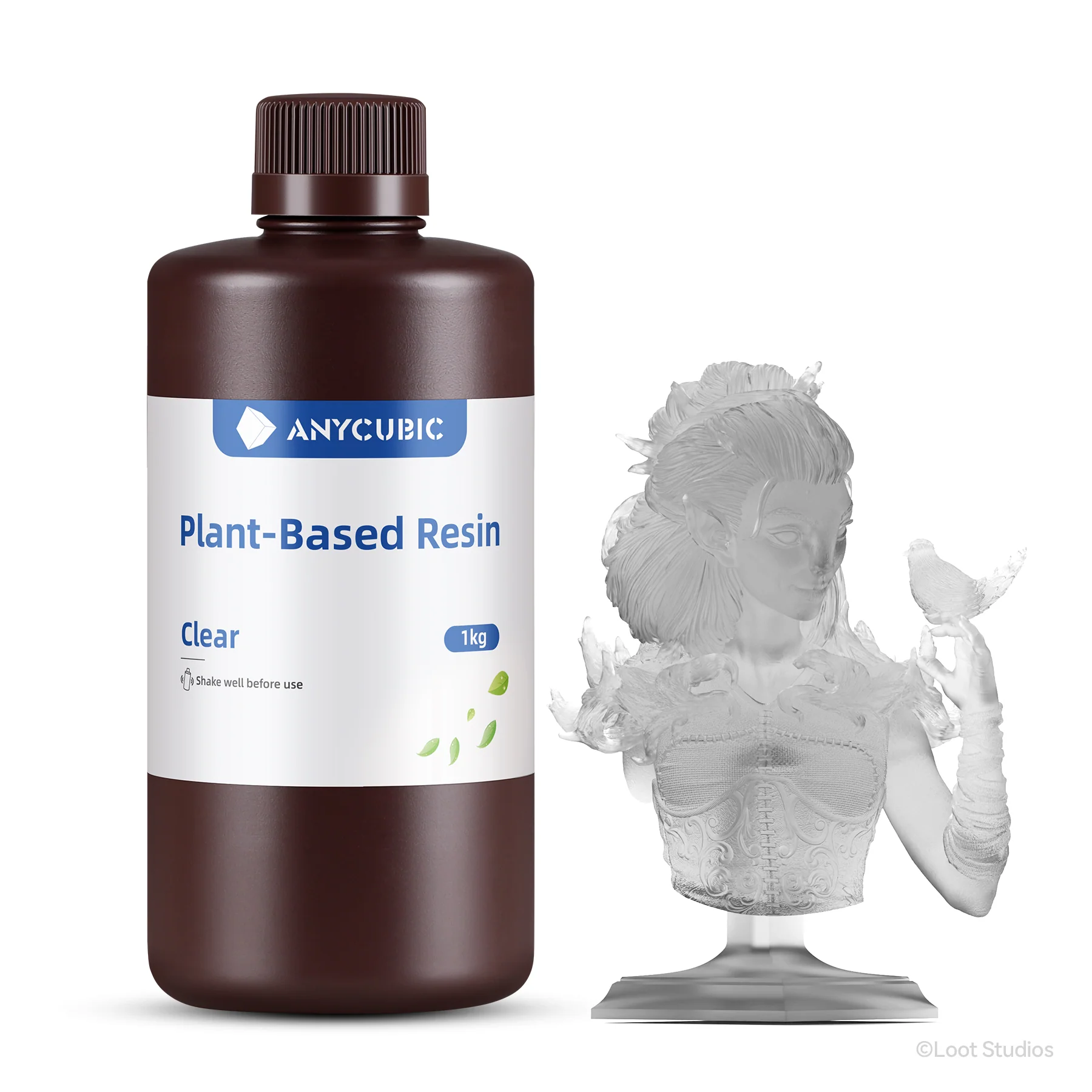


Description clear (transparent) eco plant-based uv resin anycubic 1kg
Anycubic Plant-Based UV Resin Clear — Transparent Plant-Based Photopolymer for 3D Printing
Product Description
Anycubic Plant-Based UV Resin Clear is a transparent photopolymer resin derived from eco-friendly plant-based materials, such as soy extract. It produces minimal odor and ensures high precision, clean curing, and optical clarity. Ideal for printing decorative parts, transparent prototypes, light-guiding structures, and models with LED integration. Compatible with most LCD and DLP 3D printers using 355–410 nm UV light.
Key Advantages
- Clear, plant-based formulation
- Low odor — safe for indoor environments
- High transparency and optical clarity
- Excellent surface smoothness and dimensional accuracy
- Compatible with LCD/DLP 3D printers (355–410 nm)
Technical Specifications
| Parameter | Value |
|---|---|
| UV Wavelength | 355–410 nm |
| Viscosity (25 °C) | 150–350 mPa·s |
| Solid Density | 1.05–1.25 g/cm³ |
| Tensile Strength | 35–45 MPa |
| Bending Strength | 40–50 MPa |
| Elongation at Break | 8–12% |
| Shrinkage | 1.88–2.45% |
| Thermal Deformation Temp | >55±5 °C |
| Vitrification Temperature | >60±5 °C |
| Thermal Expansion Coefficient | 95×10⁻⁶ /°C |
| Hardness | 89D |
| Shelf Life | 1.5 years |
Usage Instructions
- Shake the bottle thoroughly before use
- Store in a sealed container away from sunlight and heat
- Rinse printed models with isopropyl alcohol or resin cleaner
- Use UV curing box or direct sunlight to post-cure models
Precautions
- Use in a well-ventilated area
- Wear protective gloves, avoid skin contact
- In case of contact, wash thoroughly with soap and water
- Do not ingest or allow contact with eyes
- Keep away from children
Frequently Asked Questions
- Can I achieve crystal clarity? — Yes, with proper curing and polishing, models appear very clear and transparent.
- Is this resin suitable for decorative projects? — Absolutely. Ideal for LED lighted models, artistic prints, and optical parts.
- Which printers is this compatible with? — It works with nearly all LCD and DLP 3D printers using UV light from 355–410 nm.